
Not Whoop. Not Oura Ring. Garmin.
Today Garmin officially launched the CIRQA — a screenless smart band, priced at $199.99, with no subscription required for the core health data. This is the first time Garmin has gone head-to-head with the category Whoop and Oura have owned for years. I train for triathlon and work in tech, and I went through every official spec Garmin published on launch day to figure out if this actually changes anything.
Full disclosure: the band only opens for order in the US on July 24, and it isn’t available to order where I am yet — so this is a launch-day breakdown based on Garmin’s official specs and the initial coverage from outlets who got early access, not a multi-week wear test. Once I can get my hands on one, I’ll follow up with real hands-on impressions.
What is the CIRQA, exactly?
CIRQA is a screenless health and fitness band — one physical button, a 24mm fabric ComfortFit strap on quick-release pins, and roughly 21 grams total. It’s built to be worn 24/7, including through sleep, without the bulk of a watch on your wrist. Garmin is essentially taking the entire health engine from a Fenix or Forerunner and stripping the screen off it.
It ships in four colors — black, French Gray, Mauve, and Navy — in two sizes (S/M and L/XL), with replacement bands sold separately, including an upper-arm option for people who’d rather not wear it on the wrist.
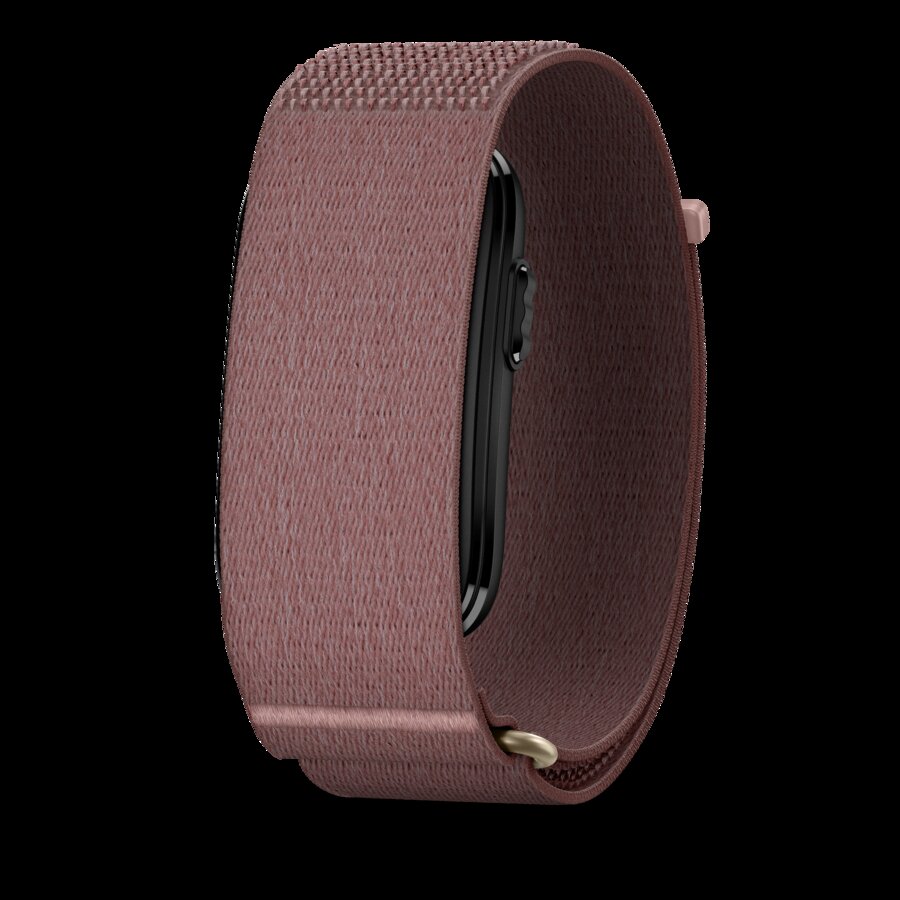
Image: Garmin
Full spec sheet
- Price: $199.99 in the US (£179.99 in the UK, €199 in the EU)
- Battery: up to 10 days
- Water rating: 5 ATM, swim-rated
- Sensor: Elevate Gen 4 (not Garmin’s newest sensor generation)
- Connectivity: Bluetooth and ANT+, connected GPS via phone (no onboard GPS)
- Memory: 256MB
- Charging: Garmin’s proprietary charging cable
Health and training metrics: Body Battery, HRV Status, recovery time, training load, Training Effect, Health Status, Training Readiness and Training Status, VO2 Max, all-day stress, respiration rate, Fitness Age, continuous heart rate, Pulse Ox, advanced sleep tracking (sleep score, Sleep Coach, sleep stages, naps, skin temperature), women’s health tracking, and wheelchair mode.
Activities: 80+ activity profiles via the button or the app, with automatic detection for common activities.
No screen — every data point flows straight to Garmin Connect on your phone.

Image: Garmin
So what about the subscription? This is the interesting part
This is the detail that actually makes CIRQA worth paying attention to: every core metric — Body Battery, HRV, sleep, stress, Training Readiness — is completely free in Garmin Connect, permanently. There’s an optional layer called Garmin Connect+ ($6.99/month or $69.99/year) that unlocks extras like guided workouts, Garmin Coach plans, and nutrition tracking — but it’s not a gate in front of the core metrics themselves.
That’s the exact opposite of the competition:
- Whoop 5.0: no upfront hardware cost, but you can’t access any data at all without a membership — $199 to $359 a year depending on the tier.
- Oura Ring 4: $349 to $499 for the ring itself, plus $69.99/year ($5.99/month) just to see the basic data.
Garmin is the only one of the three where a single one-time payment gets you permanent access to the data — not just hardware with nothing behind it.
Versus Whoop and Oura — who actually wins?
On paper, this looks like a clean win on price. But it’s worth being careful here: both Wareable and GarminRumors, who covered the launch, flagged a real weak point — the Garmin Connect app, for everything it does, simply isn’t built to feel as “recovery-first” as the purpose-built apps from Whoop and Oura, which were designed from the ground up around a screenless experience. Other brands (Polar, for one) have already stumbled in this exact category because their software couldn’t support a screenless product well enough.
There’s also something that bugs me personally: if Garmin already built an upper-arm band as an option, why not just include it in the box? Charging an extra $49.99 for a spare band feels like a missed opportunity from a brand whose entire ecosystem is built around workout heart-rate accuracy.
Who is this actually for?
If you already own a Fenix, Forerunner, or any other Garmin watch, CIRQA probably isn’t for you — you’re already getting all of this from your watch.
CIRQA is aimed at two kinds of people: those who want health data while sleeping without a bulky watch on their wrist (basically an evolution of Garmin’s earlier Index Sleep Monitor, with better battery and a friendlier price), and people considering Whoop or Oura but put off by paying a subscription forever just to see their own data.

Image: Garmin
Launch-day verdict
$199.99, no mandatory subscription, running the same algorithms Garmin has already proven work on its watches — that’s a genuine shift in this category’s pricing model, not just another product. The real question isn’t the price; it’s whether the Connect app can actually present this data in a way that feels like Whoop or Oura, instead of just another screen buried in a sports-watch companion app.
Once it’s actually available where I am and I can get my hands on one, I’ll update this with real hands-on impressions. In the meantime — Whoop, Oura, or did Garmin just catch you off guard?