
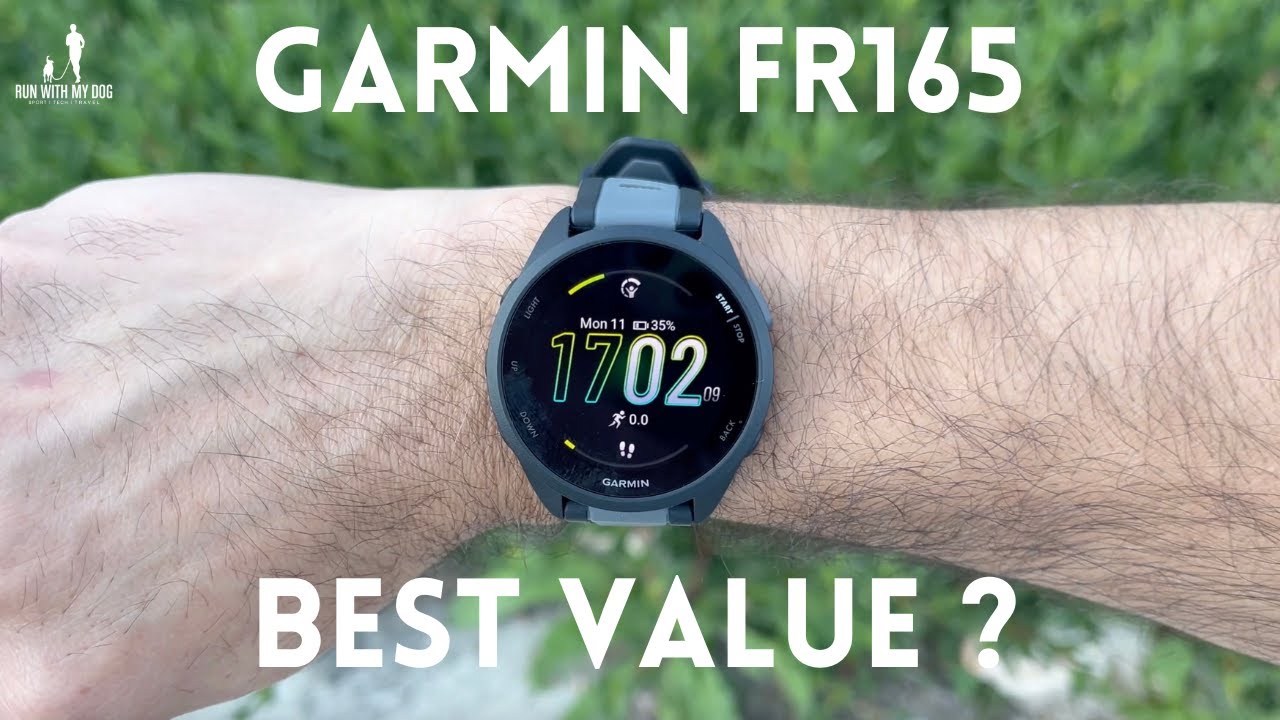
Another Garmin release — they’ve been busy. The Forerunner 165 sits at the bottom of the Forerunner lineup, joining the 265 and 965 that came out in the past year. Entry-level doesn’t tell the whole story here.
Design and Build
43mm case, full polymer body — but it doesn’t feel cheap. The strap is a step below the rest of the package and could use more attention. 20mm QuickRelease band makes third-party swaps easy.
Weight: 39g — one of the lightest sport watches I’ve worn.
Display
AMOLED, 1.2”, 390×390 — noticeably nicer than anything Garmin has offered at this price point before.
Versions and Pricing
Two variants:
- Without music: ~$199 — black or white only
- With music: ~$249 — black, white, teal, and aqua
$50 for the music version. If you run with Spotify, it’s worth it.
Battery
- Smartwatch mode: 11 days
- GPS: 19 hours — covers most ultramarathon distances
- GPS + music: 6.5 hours — enough for a marathon
Sensors
- Elevate 4 — Garmin’s latest generation heart rate sensor, more accurate than previous versions
- Blood oxygen, real-time altimeter, compass, accelerometer
- Standard GPS — not dual-frequency (unlike the 965)
- 5ATM — shower, rain, open water, pool (not diving)
- 4GB storage (music version) — not a lot, but enough for playlists
Sports and Training
Solid sport profile selection: all running types, indoor/outdoor cycling, pool and open water swimming, yoga, strength, pilates, and more.
What’s missing: no triathlon profile — a puzzling omission. Winter sports (skiing, etc.) also not supported.
What’s included:
- Daily Suggested Workouts — smart daily training recommendations based on your fitness and recovery
- Race Widget — set a target race date, get a structured plan leading to it
- Morning Report — daily sleep analysis and suggested training load on wake
- HRV Status — overnight heart rate variability to help calibrate effort day to day
- Garmin Pay — yes, even on the entry-level model
One limitation: training load metrics are fairly basic. If detailed load analytics matter to you, the 265 or 965 are worth considering.
I wore it for several nights and the sleep analysis tracked closely with a dedicated sleep app I run on Apple Watch — reassuring validation.
What’s Not Here
- No onboard maps — basic course navigation only
- No power meter or trainer connectivity
- No running dynamics from external HRM straps
- No triathlon profile
Summary
The Forerunner 165 is a very good watch — light, comfortable, sharp display, solid training tools, and a reasonable price.
Its direct competitor is the Coros Pace 3, which is worth comparing.
“In a perfect world, Garmin would make two Forerunners — the 265 and the 965. The 165 feels like it has almost everything, but was deliberately held back from being the 265.”
Who it’s for: Almost everyone. If you’re not a triathlete, don’t need maps, and aren’t chasing advanced load analytics — it’s hard to find a better running watch at this price.
Want to see it in action? Watch the full video above.