
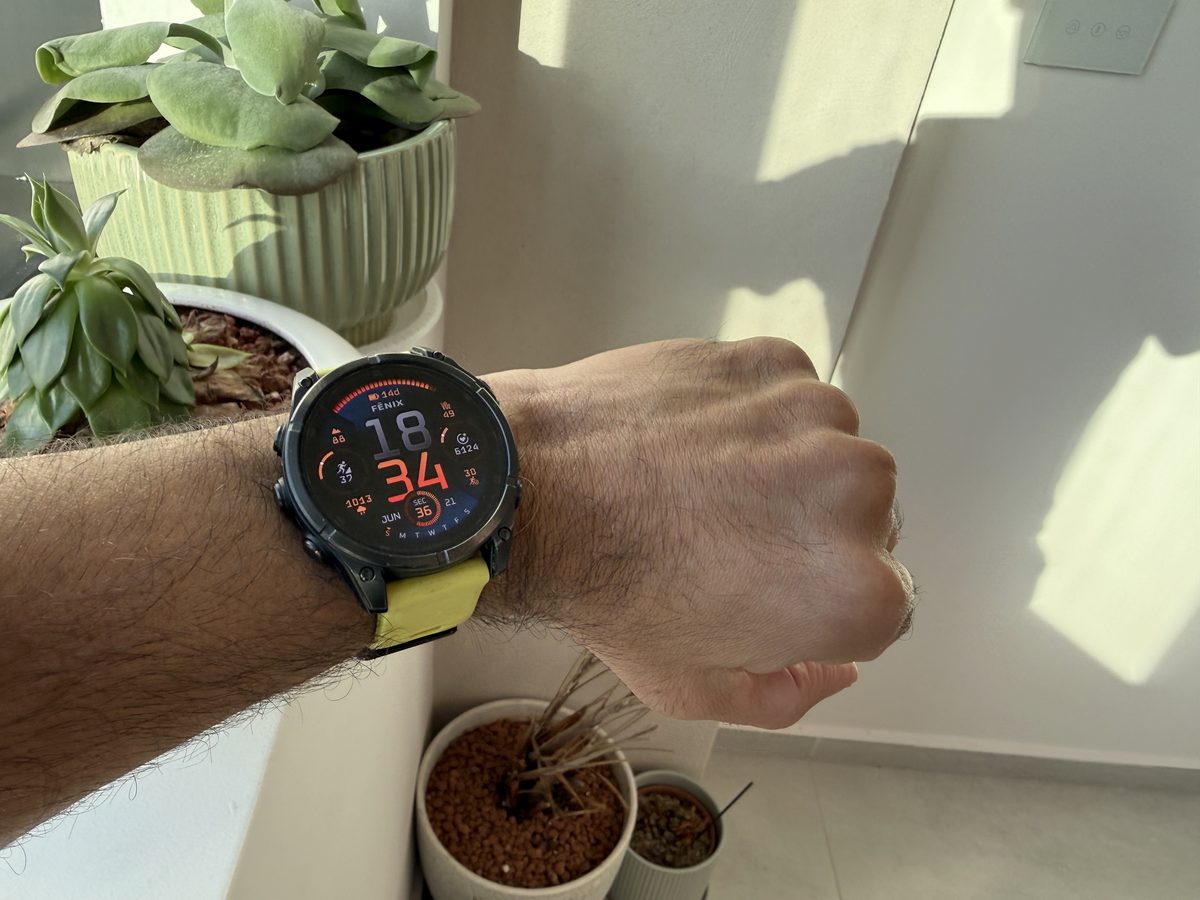
So — 18 months with the Fenix 8.
Past the honeymoon phase, past the initial excitement. Are we at “looking for the exit,” “comfortable with each other,” or is it still love?
What I Actually Use It For
Before the details — here’s the full list of what I do with it daily:
- Running with Daily Suggested Workouts
- Listening to music and podcasts from the watch
- Swim training
- Strength training
- Yoga
- Sleep tracking and health metrics
- Smart notifications and calls
- Payments with Garmin Pay
- Checking VO2 Max, training load, and HRV
And of course — the flashlight. We need to talk about this.
The Flashlight — Gimmick? Not Even Close
It always sounds like a gimmick. Hear me out.
It’s such a legitimate killer feature that when I’m not wearing the watch, I still instinctively double-tap my wrist to turn it on. I use it every single day — in the dark when getting up for the kids, walking the dog, taking out the trash, when someone says “can you light that up for a sec” — I’m ready without reaching for my phone.
And running at night, especially in winter when it gets dark early — the watch flashes automatically while you run.
There’s no going back. I’d rather have a watch that doesn’t show the time than one without a flashlight. (Totally objective take.)
Running — The Core Use Case
We ran everywhere. With the onboard maps, all I needed was a downloaded route and I was off — through forests in Germany, trails in Israel, and streets full of… well, in India.
Daily Suggested Workouts
One of the best features on the watch. Every day it suggests a personalized workout based on recent training load and current fitness status. I follow the suggested workout on almost every run — it keeps things varied and I never get bored.
I also run without my phone, so syncing podcasts and Spotify playlists to the watch is essential. Note: music roughly doubles battery consumption.
Strength Training — A Real Differentiator
This was the biggest thing I missed when I briefly tried switching to Apple Watch. From building workout plans and muscle maps to rep detection, weight logging, and rest timer between sets — it’s a primary reason I stay on Garmin.
Swimming — Almost Perfect
Almost zero missed laps — something that existed in every previous Garmin I owned. Significant improvement.
Sleep Tracking — 7/10
Generally accurate: sleep hours are right, HRV reflects how I actually feel, and the daily readiness score is reliable.
Where it falls short:
- Wake up and go back to sleep? It rarely combines both sleep windows
- Naps? Almost never detected. As a committed napper — frustrating
Sleep score: 7/10 — excellent for a normal night, needs work for anything outside that.
Notifications and Calls — 6/10
Smart notifications work well, including a dedicated WhatsApp app (see my video on that).
The speakerphone feature is where Garmin dropped the ball. As someone who isn’t always carrying their phone and uses it for quick “I’ll be right out” calls — people couldn’t hear me properly, complained about background noise, heard themselves echoed, or I couldn’t answer at all.
Software updates have improved things — but not dramatically.
Call quality score: 6/10 — great idea, mediocre execution.
Garmin Pay — Useful, With a Twist
More than once after a race or triathlon in Eilat when bags and phones weren’t allowed, my only lifeline was a lone iced coffee on the boardwalk, just me and the watch.
The issue: most cards I tried don’t work. I ended up setting up my wife’s Visa, which means every time I buy a Coke she calls to ask what I bought.
So — as long as you’re not using it for anything you’d rather keep private, you should be fine.
Training Load Metrics — The Inner Geek
I check my VO2 Max every day and try to keep the anaerobic, high aerobic, and low aerobic graphs balanced. Having all that data on my wrist means I’m constantly fiddling with my own stats. If I went back to Apple Watch, this would be one of the first things I’d miss.
Battery — Good++
Coming from an Apple Watch world where ending the day with any battery life was an achievement — this is a different universe. Despite running, listening to music, and heavy daily use, I charge it once a week, when it hits around 20%. Genuinely fine.
I gave up Always-On display — otherwise I’d be charging every four days.
Design
I swap bands constantly — I even have an elegant strap for events. I think it looks significantly better than the boxy, geeky rectangular Apple Watch aesthetic.
That said — I did manage to scratch the sapphire glass. Since I bought it locally, it was replaced under warranty. I’ve been more careful since.
Bottom Line — Worth the $900?
Eighteen months. Forests in Germany, trails in Israel, cow-covered streets in India. There’s no better travel companion.
Pros: strong battery, comprehensive sleep tracking, onboard maps, training statistics, smart workout suggestions, offline music, sensors and accessories, and the flashlight.
Cons: mediocre call quality, weak nap detection, some cards not supported on Garmin Pay.
Is it worth the price? Most people would say no. There are Garmin watches at half the price that do a lot of what the Fenix 8 does — and previous generations handle most of it too.
I don’t regret it. And I think we’ve still got some quality time ahead — at least until the Fenix 9 drops.